Aurora Forecast & Space Weather
Real-time Northern Lights prediction for Iceland using advanced space weather monitoring
NOAA Aurora Forecast
Live aurora oval and KP forecast from the NOAA Space Weather Prediction Center
Aurora Oval (OVATION Model)
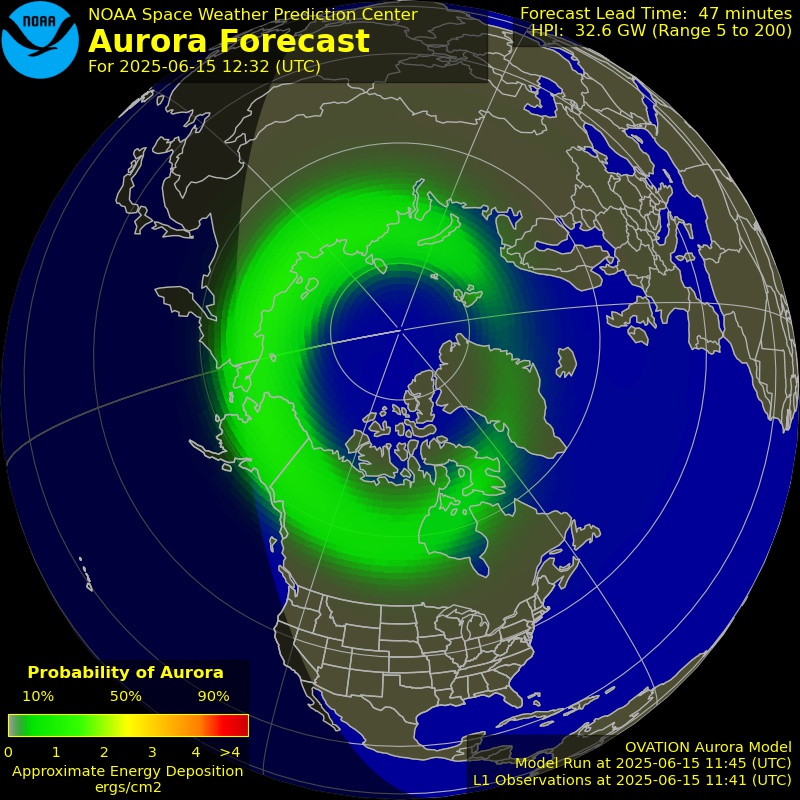
Aurora probability map updated every ~30 min by NOAA. Green band shows where aurora is most likely. View on NOAA →
3-Day KP Forecast
Forecast from NOAA SWPC. KP 3+ = aurora visible in rural Iceland; KP 5+ = visible near cities.
Understanding the KP Index
The KP index is your primary tool for Aurora forecasting. It measures global geomagnetic activity on a scale of 0-9, updated every 3 hours by NOAA. The estimated KP shown above uses 1-minute resolution data for near-real-time tracking.
KP Index Guide for Iceland
The Critical Bz Component
The Bz component of the Interplanetary Magnetic Field (IMF) is the most important real-time indicator for Aurora activity.
Understanding Bz Values
- Bz Positive (+): Points north, aligns with Earth's field → No Aurora
- Bz Negative (-): Points south, can reconnect with Earth's field → Aurora possible
- Stronger negative values: Generally increase Aurora probability
- Duration matters: Sustained negative Bz more important than brief dips
- For strong auroras: Look for Bz values of -10 nT or stronger, sustained for 30+ minutes
Timing Your Aurora Hunt
Solar wind data from the L1 Lagrange point (DSCOVR satellite) reaches Earth in 45-60 minutes. When you see favorable Bz values, you have about an hour to get ready!
Solar Wind Parameters
Key Solar Wind Measurements
Solar Wind Speed
- 300-400 km/s: Slow solar wind, minimal Aurora enhancement
- 400-500 km/s: Moderate speed, normal Aurora activity
- 500-700 km/s: High speed, enhanced Aurora intensity
- 700+ km/s: Very high speed, potential for strong storms
Solar Wind Density
- 1-5 protons/cm³: Low density
- 5-15 protons/cm³: Normal density
- 15+ protons/cm³: High density, enhances magnetic effects
Space Weather Events
Coronal Mass Ejections (CME)
What is a CME?
A CME is a massive burst of solar plasma and magnetic field released from the Sun's corona. CMEs can cause multi-day Aurora storms when they reach Earth.
High-Speed Solar Wind Streams
These originate from coronal holes on the Sun and create recurring Aurora activity patterns, often repeating every 27 days (one solar rotation).
Essential Forecasting Tools
Real-time Data Sources
- NOAA Space Weather Prediction Center: Official space weather alerts, KP forecasts, and real-time Bz data
- DSCOVR Real-time Data: Live solar wind measurements from L1 Lagrange point
- SpaceWeatherLive.com: Comprehensive space weather monitoring with alerts
- Aurora Service Europe: European Aurora forecasts
- Iceland Met Office: Local cloud cover forecasts
Forecast Reliability
- Real-time data (above): Most accurate for immediate decisions
- 3-hour forecasts: Most reliable for planning
- 24-hour forecasts: Good for travel planning
- 3-day forecasts: General trends only
Weather Integration & Cloud Strategy
Cloud Cover — The Aurora Hunter's Enemy
Even with perfect geomagnetic conditions, clouds will block Aurora visibility. Iceland's weather is notoriously changeable, making cloud forecasting crucial.
Weather Strategy
- Check multiple forecasts: Vedur.is, Windy.com, yr.no
- Look for clearing trends: Even partial clear skies can work
- Be mobile: Drive to clearer areas if possible
- Patience is key: Weather can change rapidly in Iceland